
Initial Situation
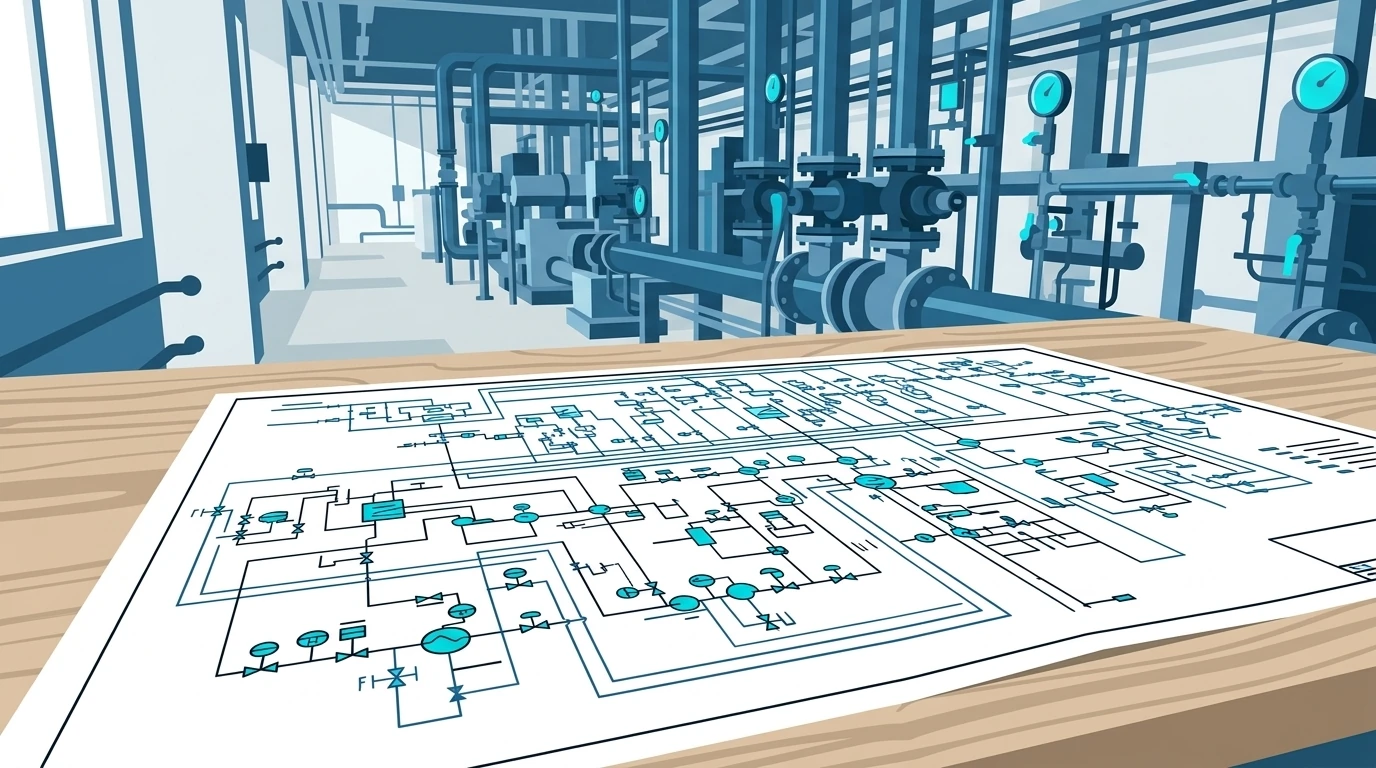
A chemical industry company wanted to make the creation of Environment, Health and Safety (EHS) risk assessments more reliable. Before maintenance work or modifications to plants, safety specialists, plant planners, and compliance officers assess the associated hazards. They read job descriptions, compare them with relevant safety standards, and transfer the results into a fixed report format. In parallel, they analyze technical flow diagrams, known as Piping and Instrumentation Diagrams (P&IDs), which document a plant's equipment, piping, and safety functions.
This process is technically demanding. Chemical plants are subject to strict regulations, including ATEX and the DIN EN ISO series of standards. Risk assessments are mandatory before any intervention on a plant, and the quality of the documents depends heavily on the expert time available. The company sought a way to prepare standards-compliant reports faster without replacing technical approval by safety experts. The application needed to process text and complex diagrams to derive comprehensible draft assessments.
Our Solution
AMAI We developed a web application that prepares risk assessments from two sources: work process descriptions and P&ID flowcharts. Safety standards are integrated as a searchable knowledge base. Large language models use this data to generate drafts for structured reports, which experts then review and utilize.
- Standards research via dialogue:Safety experts ask questions about EHS requirements directly against the stored standards. A semantic search usingAzure AI Searchfinds relevant passages in DIN EN ISO series documents and related safety regulations. Retrieval-Augmented Generation connects these findings with a large language model, ensuring the answer remains tied to the specific process. Sources remain traceable.
- Reports from job descriptions:The application generates a structured risk assessment report from a job description. The language model compares the activity with the relevant requirements and converts the result into the established report format, both as a PDF and a spreadsheet. Hazards, affected plant components, and recommended measures follow a fixed structure. The draft is then submitted for technical approval. The system shortens the path from task description to reviewable document.
- Multimodal analysis of flow diagrams:P&IDs are provided as graphics. Labels for equipment and piping are read directly from the file without optical character recognition or a custom-trained image recognition model. For image analysis, the application replaces the text sections with neutral markers. A vision-capable language model onAzure OpenAIreads roles and connections from them. A second model interprets the technical codes. Both results flow into a process description and a preliminary risk assessment.
- Background generation:Multiple model queries evaluate text, diagrams, and standards. The application performs these steps in the background and displays progress in the browser. Safety specialists download the finished document.
The particular challenge lay in the flow diagrams. P&IDs are dense, contain many codes, and connect components over long distances on the sheet. A simple image description is insufficient because the meaning only emerges from the combination of graphics and labels. Separating visual structure from textual interpretation keeps both levels verifiable. Additionally, symbols and metadata from existing export data can be used for further recognition steps without having to train a model from scratch.
Results & Business Impact
The parallel execution of model queries has accelerated report generation by 50 percent. The text-based part—the comparison of job descriptions with standards and the output of structured reports—achieved a quality sufficient for productive use. The analysis of P&ID flow diagrams is now available. Diagrams are converted into a process description and a preliminary risk assessment without the need for a retrained recognition model.
For the EHS organization, this reduces the manual effort required for data transfer and standards research. The obligation for technical review remains. Expert time is now available for the assessment itself, rather than for gathering standards or transcribing diagram contents. A draft with source references is more robust in safety-critical documents than free text. Semantic search across standards and multimodal analysis of flow diagrams can be applied to other plant types.