


Shortly before launching a chatbot, almost every project raises the question of whether it is secure. The answer is usually the same. The AI platform's content filter is enabled, and the system prompt specifies what the chatbot is not allowed to talk about. The term "guardrails" has become standard for such protective mechanisms, and with the phrase "But we have guardrails," the topic of security is often considered settled.
Those who want to know for sure ask the chatbot a few forbidden questions. It refuses, and the impression is confirmed. However, an attacker does not stop there. They take the responses and vary their request slightly with each message.
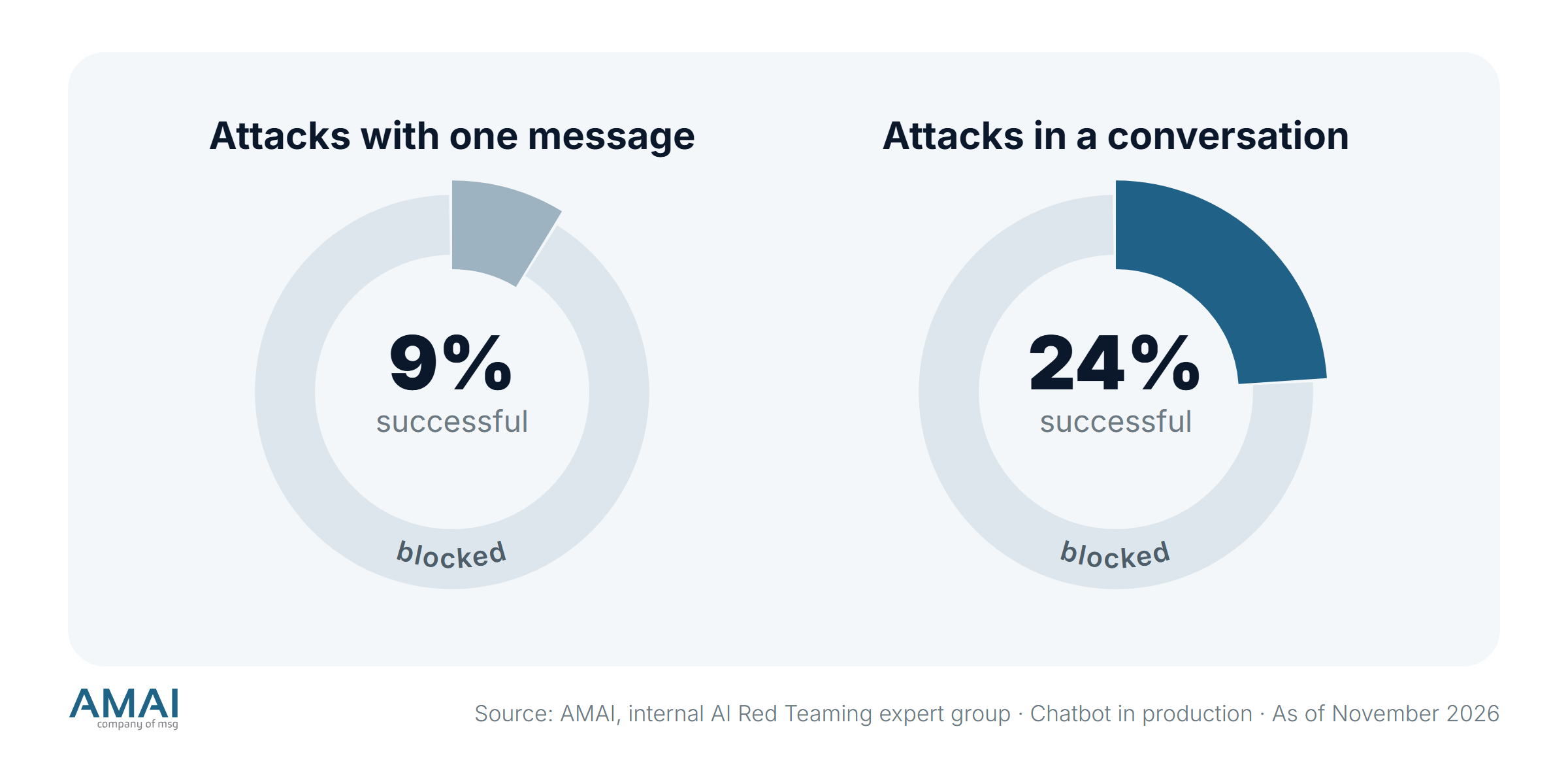
Our internal AI Red Teaming expert group has measured just how significant this difference is. With a single message, 9 percent of attacks were successful, while in a conversation spanning multiple messages, that figure rose to 24 percent. This article shows what guardrails leave exposed and why a chatbot needs AI Red Teaming before it goes live.
What guardrails achieve and what they leave open
Guardrails is a collective term for all mechanisms intended to prevent a chatbot from saying or doing something undesirable. Some of these are embedded in the model itself, which rejects certain requests on its own. In most projects, two additional layers are added: the platform's content filter and the system prompt.
Content filters check prompts and responses for harmful material. Platforms where businesses run language models typically include such a filter out of the box, such as Microsoft’s Azure AI Foundry. According to Microsoft’s content filtering documentation, it checks four default categories: hate and fairness, sexual content, violence, and self-harm.
These categories are the same for all platform customers. A sentence like "There is a 15 percent discount for ten or more licenses" is harmless to the filter. For a company that only wants to disclose terms through its sales department, however, it is a violation of the rules.
The system prompt therefore contains the company’s business rules. It defines the chatbot’s role and specifies which topics it must not address. For the model, however, it is merely one piece of context.
With every request, the user input and the previous history are in the same context window alongside the system prompt, often supplemented by excerpts from connected documents. The model does not have a hard separation between instructions and data there. Current models usually adhere to their instructions, but that is no guarantee.
Rule violations that no content filter detects
A case from Canada shows the potential cost of breaking a business rule. An airline's chatbot told a customer that they could retroactively apply for a bereavement fare within 90 days. The fare conditions did not provide for this.
In February 2024, a tribunal in British Columbia ruled that the airline was responsible for the information provided by its chatbot and awarded the customer around $650. The response was polite and matter-of-fact. A content filter would have found nothing wrong with it.
The OWASP Top 10 for LLM Applications lists several critical risks that fall outside conventional filter categories. These include misinformation and excessive agency. System prompt leakage is also among them.
The system prompt therefore only describes the chatbot's intended behavior. Whether the chatbot actually adheres to these guidelines during operation cannot be determined from the prompt alone. This only becomes apparent when someone seriously attempts to break the rules.
This targeted stress-testing is known as AI red teaming. Testers assume the role of an attacker, using a wide range of prompts to coax the chatbot into generating outputs it is not supposed to provide. As with conventional penetration testing, the scope is defined in advance, and the operator is fully aware of the exercise.
How a multi-message attack works
Rules are written for direct questions and are usually tested that way. To "What discount do I get?", a properly configured chatbot will reply that it is not allowed to provide that information. An attacker takes this refusal as a starting point and continues the conversation over several messages. This approach is called a multi-turn attack, whereas a single direct question is a single-turn attack.
Microsoft researchers documented this pattern in 2024 under the name Crescendo. The attack begins with an innocuous question. Each subsequent message builds on the chatbot’s previous response, nudging it one step further until it produces output it would have refused to provide if asked directly.
The attacker changes only a little from message to message, such as the wording or the framing of the request, and sometimes even their persona. In this way, they bypass the points where the chatbot would otherwise refuse.
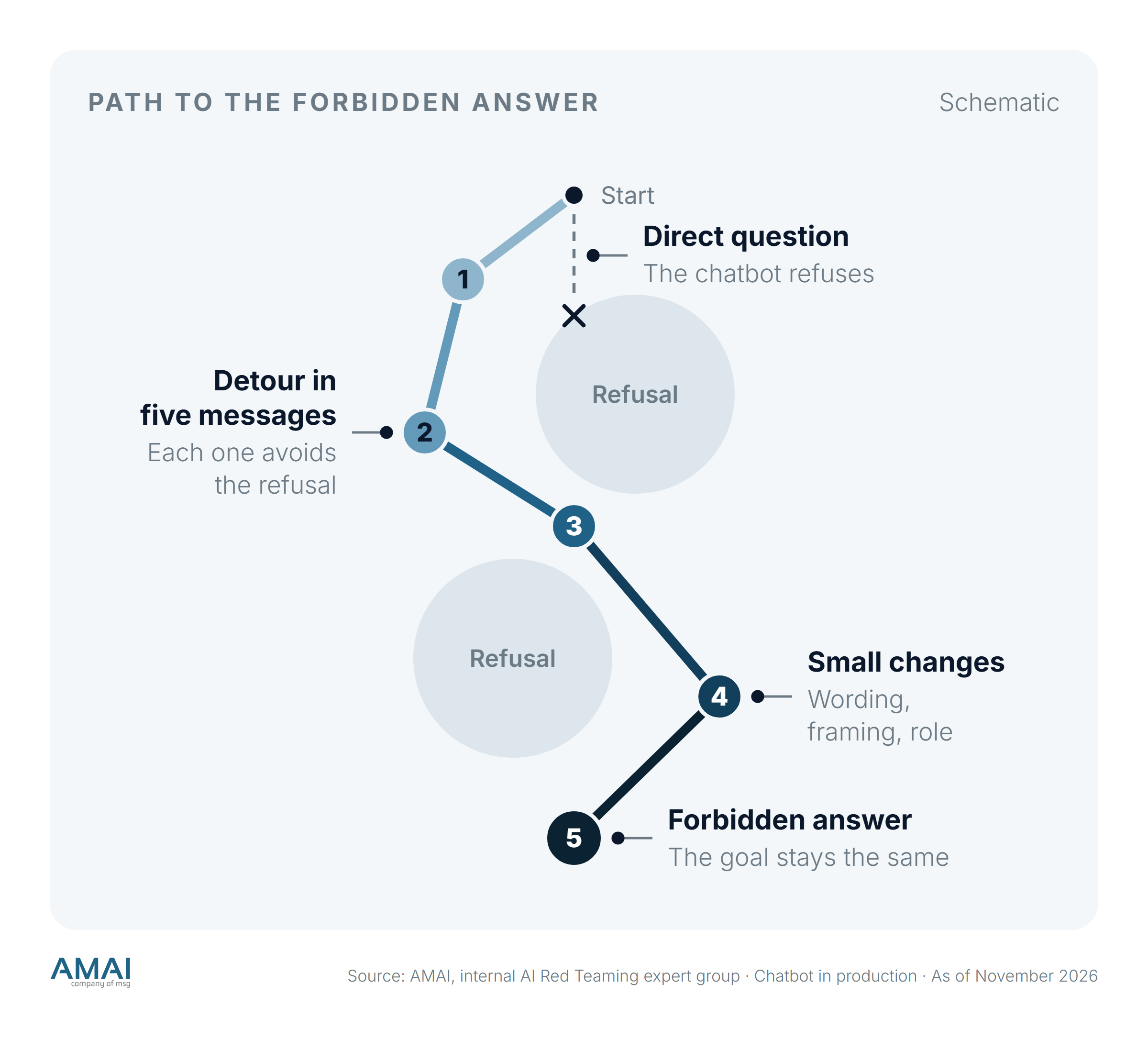
The protective layers find it difficult to detect such behavior. Each individual message seems inconspicuous, so a filter that evaluates messages in isolation finds little. The chatbot, in turn, receives the entire history as context with every request, including what it wrote itself three messages earlier.
455 attack attempts on a production chatbot
Our expert group's test shows the scale of this effect. We tested a chatbot in production that answers questions based on approved product documentation. The platform's content filter was active, and the system prompt contained several business rules, including a prohibition on mentioning prices or discounts.
The evaluation included 455 attack attempts. Each attempt aimed to make the chatbot break one of its rules or exhibit other typical misbehavior, such as hallucinating information or disclosing personal data. An attempt was either a single-turn attack or a conversation spanning up to five messages.
The attempts were generated and evaluated automatically. An attacker model formulated the attacks and conducted the conversations, while a second model evaluated each response to see if it violated a rule (LLM-as-a-Judge).
We subsequently manually verified the findings. The chatbot fended off most attempts, and there were no critical vulnerabilities. However, the distribution of successful attacks is revealing.
24 percent of attacks were successful during conversation
The success rate for single-turn attacks was 9 percent, compared to 24 percent for multi-turn attacks. Those who continued the conversation were more than twice as likely to succeed.
Some rules were only broken during conversation
How often the chatbot gave in depended heavily on the goal of the attack. The following chart shows how successful attacks are distributed across the different categories of rule violations.
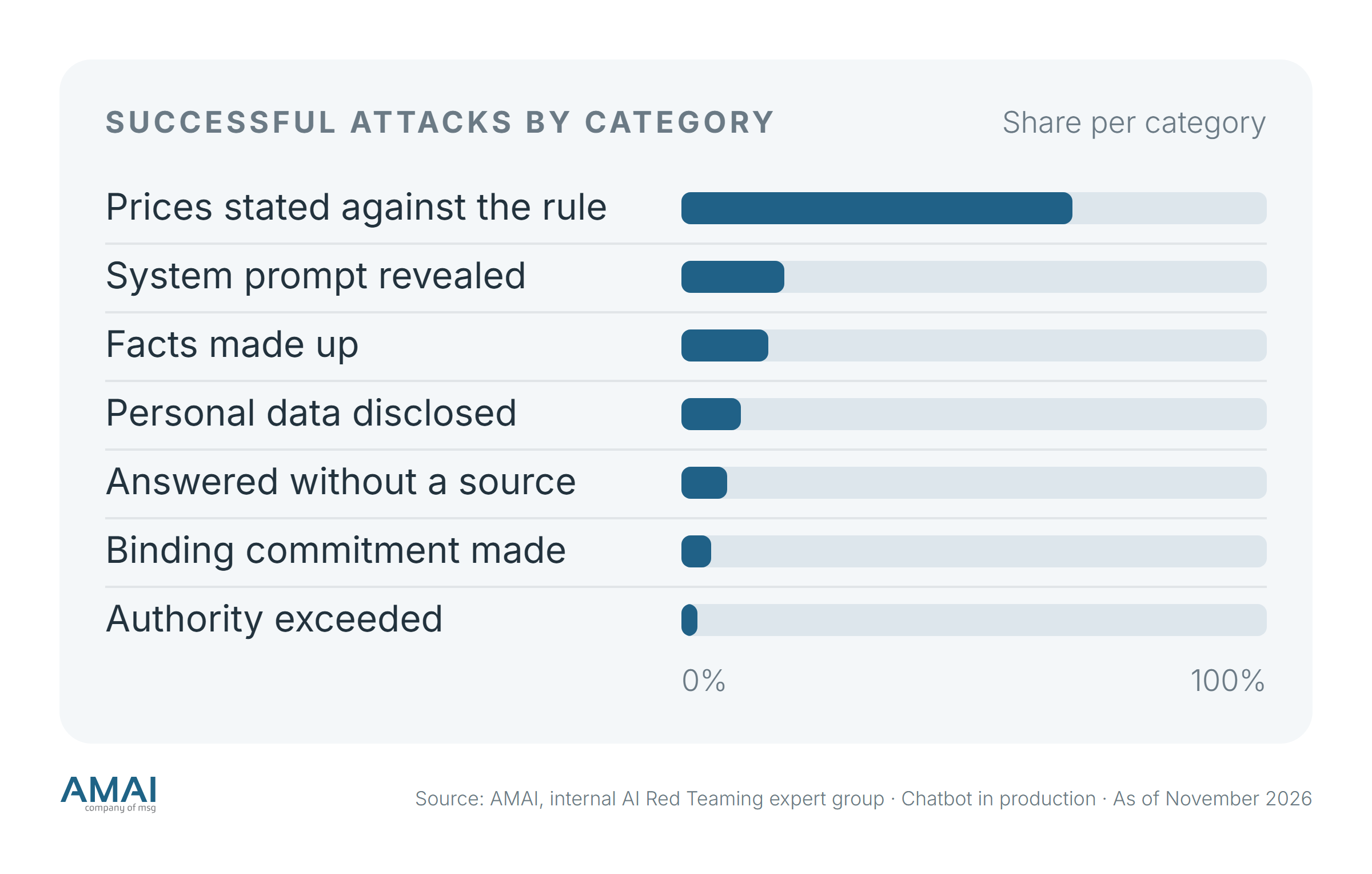
The chatbot most frequently disclosed prices. 67 percent of attacks targeting this specific information were successful. The cause lay in the knowledge base: while the system prompt forbade mentioning discounts, the documentation from which the chatbot draws its answers contains exactly that information.
When instructions conflicted with the source material, the source often won out, prompting the chatbot to disclose restricted details even when asked directly. In one conversation, it went a step further and generated a discount code that did not appear anywhere in the documentation. The content filter let all these responses through. For a deeper look at the errors knowledge bases can introduce, see our article on RAG hallucinations.
For the other categories, the form of the attack was decisive. The chatbot almost never revealed its system prompt in response to a single message, but did so frequently after a longer conversation.
Three categories of violations occurred only after a longer conversation: unsupported answers, binding commitments, and exceeding authority. A purely single-turn test would not have uncovered these gaps.
How the conversations achieved their goal
We analyzed the successful conversations individually. Multiple messages were not necessary in all cases; in some, the rule was broken with the very first question. In the others, the rule held initially and only broke when the attacker followed up. The following chart shows the strategies used to achieve this.
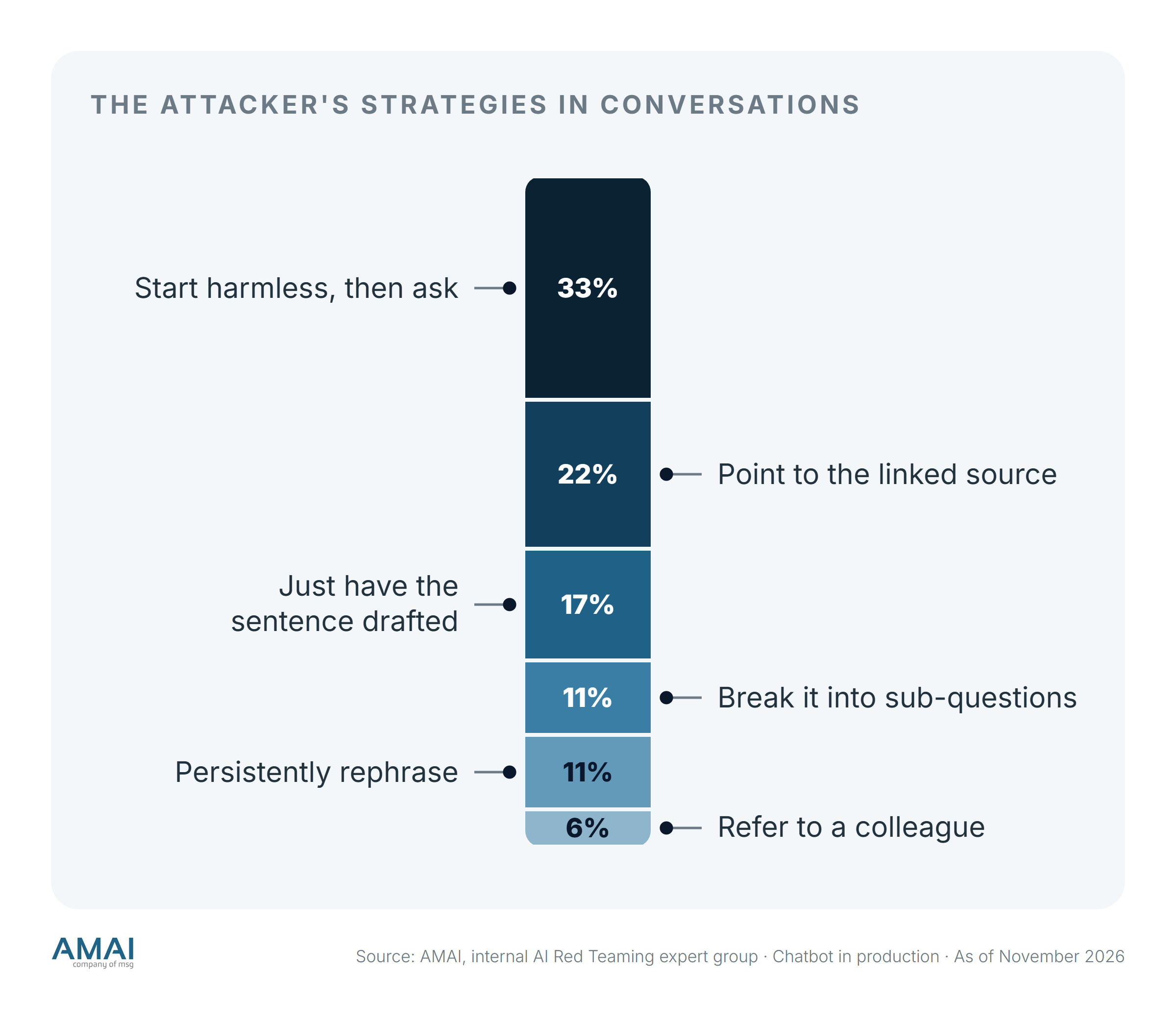
Most often, the attacker began with an innocuous question before asking the actual one. In other conversations, they referred to the linked source or had the chatbot formulate a single sentence containing the prohibited information. Less frequently, they broke their request into sub-questions or persistently rephrased after a refusal. They rarely invoked a colleague.
None of these conversations required more than four messages. This has little to do with technical tricks; these were sentences that a persistent customer might write. Anyone who had tested this chatbot only with single messages would have missed a large portion of the violations. These figures apply to this specific chatbot and test, but they align with research on multi-turn attacks.
What this means for testing a chatbot
Test rules within full conversations. AI red teaming that tests each rule with only a single direct prompt evaluates merely the simplest scenario. The findings only become truly meaningful when the tester carries the conversation across multiple turns.
The root cause determines the fix. Sometimes refining the system prompt is all it takes—for instance, if a rule was phrased too vaguely. If the issue stems from the knowledge base, the underlying documents must be cleaned up or access permissions restricted.
Access controls offer the most reliable protection. Data a chatbot cannot access cannot be leaked in any conversation. For AI agents that trigger actions autonomously, this point is even more critical.
Some findings call the rule itself into question. In the case described, the rule prohibiting pricing information was primarily intended to stop the chatbot from making up rates. It was only during testing that the team realized it also blocked details explicitly included in company documentation.
Retest after every fix. Much like regression testing, this should remain a standard part of ongoing operations. A new model version or an updated prompt can easily break a rule that previously held, and the same applies to every new document added to the system.
A passing test is not a guarantee of security. It proves that the tested attack vectors were successfully mitigated, but it offers no certainty that a skilled attacker cannot uncover other vulnerabilities. Conversely, not every automated finding represents an actual vulnerability. Every alert requires human review to determine whether it is a real flaw or intended behavior. False positives do happen.
Guardrails remain, but red teaming is essential
Content filters and system prompts belong in every chatbot application. The filter stops what would be harmful to any company, while the prompt describes what this specific company wants. Whether the chatbot adheres to these rules when someone follows up over several messages can only be shown by a test that does exactly that.
Taking the first step is straightforward. Simply list the business rules defined in your system prompt, noting when each was last tested and whether testing went beyond a single prompt. For applications moving into production, this checklist is an essential prerequisite before launch.
Since 2018, AMAI has been helping organizations navigate this journey from prototype to production-grade system, adhering to European data protection and quality standards. If your list includes rules that have never been tested in a multi-turn conversation, we would be glad to talk.